The Boxes We Forget: What Epidemiology Taught Me About Cancer Infrastructure

Reading Eras in Epidemiology, and Rethinking What We Call Infrastructure” ·

A few weeks into my doctoral coursework, I sat down with Mervyn Susser and Zena Stein’s Eras in Epidemiology, a history of how my discipline slowly learned to think. I expected a reference text. I got something closer to a mirror.
The book walks through the great eras of the field. First the sanitary era, when we counted deaths and blamed bad air, and were often right for the wrong reasons. Then the era of infectious disease, when the microscope gave us single causes and the confidence that one germ made one disease. Then the era of chronic disease and risk factors, which gave us the association between smoking and lung cancer and, with it, a habit of treating the body as a black box: exposure in, outcome out, the machinery in between left unopened. And then the era Susser saw coming, eco-epidemiology, which asked us to stop choosing a single level of explanation at all (Susser & Susser, 1996a, 1996b). His image for it has stayed with me. Health, he wrote, is produced inside a set of nested boxes, one within another, the molecule inside the cell inside the person inside the family inside the society. You cannot explain what happens in one box by staring only at that box.
I read that chapter, and I could not stop thinking about a single word we use with enormous confidence in cancer care. Infrastructure.

Because when we say India needs better cancer infrastructure, we almost always mean one box, and usually the most visible one. How many linear accelerators. How many PET scanners. How many new centres a state has sanctioned. It is an understandable instinct. Machines are countable, fundable, and photogenic at a ribbon-cutting. But Susser’s whole argument was that an outcome living in the outer box cannot be fixed from the innermost one alone. So I want to walk the boxes, gently, because the picture only makes sense when you hold all of them at once.
The box we count: the physical layer
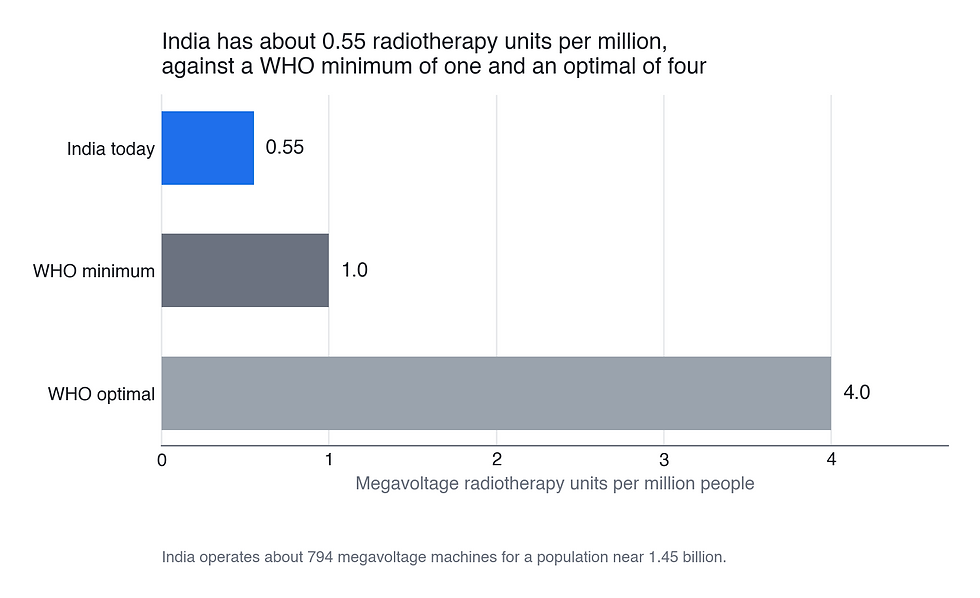
Start with what we do measure. India recorded an estimated 14.6 lakh new cancer cases in 2022, and the National Cancer Registry Programme projects a rise to around 15.7 lakh by 2025 (Sathishkumar et al., 2023). Against that load, the radiotherapy picture is genuinely tight. The WHO sets a minimum of about one megavoltage unit per million people, and an optimal of four. India sits at roughly 0.55 per million, close to 794 machines for a population near 1.45 billion, which leaves the country well over a thousand units short of the optimal benchmark (Sankarapillai et al., 2025). And because many of those machines sit in larger private hospitals in cities, the gap is felt most by patients who are furthest away to begin with.
So yes, we need more machines. That part of the conversation is real. But a machine is only ever as useful as the people standing next to it.
The box we underfund: the workforce
A linear accelerator does nothing without a radiation oncologist, a medical physicist, a radiographer, and a nurse who can manage the toxicity that follows. Here the arithmetic gets humbling. India has fewer than a thousand formally trained medical oncologists, which works out to roughly one oncologist for every two thousand cancer patients, against something closer to one per hundred in the United States (Sengar et al., 2019). A median full-day clinic sees about thirty-five patients, and a sizeable share of oncologists get through more than a thousand new consultations a year. Numbers like these are what a workforce shortage actually feels like from inside the room.

This is why a new centre can open and patients can still wait weeks to begin treatment. The building is the part we know how to commission. The trained person inside it is slow to grow and hard to distribute, and I think we find it easier, as systems, to plan for buildings than for people.
The box that decides who reaches the ward: financing
Now suppose a patient has a machine and a doctor within reach. Can they afford to use them. For a great many families the honest answer is not without lasting damage. Cancer carries the highest catastrophic health expenditure of any disease category in India (Kastor & Mohanty, 2018). A longitudinal breast-cancer cohort at the Tata Memorial Centre put catastrophic expenditure at 84.6 percent of households and distress financing at 72.4 percent (Mohanty et al., 2024). Distress financing is a quiet, clinical phrase for selling land,
pawning jewellery, borrowing at interest a household will service for years.

And the boxes press on one another. Because care is scarce, distant, and costly, a large share of patients arrive at an advanced stage, when far fewer cancers remain curable. We build our most expensive infrastructure to treat disease at the exact point where it can do the least. The gaps in the outer boxes shape the late arrival we then meet in the inner one.
The box we forget entirely
Here is where I want to slow down, because everything above is the part the field already debates. Machines, workforce, money. All necessary. None sufficient. The box that rarely enters an infrastructure conversation is the one I have spent my working life inside, and it may be the one that decides whether treatment becomes recovery or only survival.
Call it the soft infrastructure. The psychosocial support, the survivorship care, the palliative provision that runs alongside and after the medical event. It is not a comfort added at the end. It is structural, and we have barely built it.

Palliative care is the clearest test. Across all conditions, fewer than four percent of Indians who need palliative care receive it, and for people with end-stage cancer the unmet need runs to roughly 98 percent (Sharma et al., 2025). Behind that number are people in severe, treatable pain who never reach relief. A country can own a thousand linear accelerators and still fail this quietly.
Survivorship is the same gap wearing a kinder face. We rightly celebrate the patient who finishes treatment and walks out of the ward. We less often ask what she walks out into. The fear of recurrence that reorganises a life around the next scan. A body changed in ways that alter how she sees herself and how others see her. A young adult whose studies, relationships, and earning years were interrupted at the very moment they were meant to begin. That life stage, so often, is the one the follow-up system assumes needs the least, precisely when the patient feels it needs the most.
And distress is not soft in its consequences. A person carrying untreated anxiety, or the weight of having spent a family’s savings, is more likely to miss follow-up and to stop treatment partway through. The psychosocial box does not sit meekly downstream. It reaches back up and can undo the expensive work done in every box before it.
One system, not five parts
So here is the view I keep returning to, and I think Susser would have recognised it. A machine without a workforce is a warehouse. A workforce without financing serves only those who can pay. Financing that arrives only at late-stage disease buys the least curable care at the highest price. And all of it, every rupee and every machine, rests on whether a person is well enough in mind and circumstance to complete the course and rebuild a life on the other side.
There is real hope in this framing, and that is the part I want to leave you with. Kerala’s community palliative-care model, built on trained local volunteers rather than imported hardware, has shown that the soft box can be built affordably and at scale once a system decides it matters. The question is not whether India needs more machines. It plainly does. The question Eras in Epidemiology left me holding is whether we will keep trying to explain, and fix, an outcome that lives in the outer boxes by working only in the innermost one.
I write about the psychosocial layer because it is my field. I keep arguing for it because it is the box that turns all the others into care.
Bibliography
Kastor, A., & Mohanty, S. K. (2018). Disease-specific out-of-pocket and catastrophic health expenditure on hospitalization in India: Do Indian households face distress health financing? PLOS ONE, 13(5), Article e0196106. https://doi.org/10.1371/journal.pone.0196106
Mohanty, S. K., Wadasadawala, T., Sen, S., Maiti, S., & Jishna, E. (2024). Catastrophic health expenditure and distress financing of breast cancer treatment in India: Evidence from a longitudinal cohort study. International Journal for Equity in Health, 23, Article 145. https://doi.org/10.1186/s12939-024-02215-2
Sankarapillai, J., Ramamoorthy, T., Sarveswaran, G., Venugopal, G., & Mathur, P. (2025). Epidemiological analysis of radiation therapy utilization and its implications for cancer care in India: Insights from the National Cancer Registry Programme. BMC Cancer, 25, Article 1062. https://doi.org/10.1186/s12885-025-14440-1
Sathishkumar, K., Chaturvedi, M., Das, P., Stephen, S., & Mathur, P. (2023). Cancer incidence estimates for 2022 & projection for 2025: Result from National Cancer Registry Programme, India. Indian Journal of Medical Research, 156(4&5), 598–607. https://doi.org/10.4103/ijmr.ijmr_1821_22
Sengar, M., Fundytus, A., Hopman, W. M., Malhotra, H., Gupta, S., Pramesh, C. S., Hammad, N., Sullivan, R., Vanderpuye, V., Seruga, B., Lopes, G., Brundage, M. D., & Booth, C. M. (2019). Medical oncology in India: Workload, infrastructure, and delivery of care. Indian Journal of Medical and Paediatric Oncology, 40(1), 121–127. https://doi.org/10.4103/ijmpo.ijmpo_66_18
Sharma, P., Thakkar, H., Patil, A., Chauhan, P., Chembon, P., Joseph, S. A., Rana, S., Kalady, R., Wadhwani, V., Urs, G., Krishna, P., Sangma, R., Bijalwan, R. D., Samal, S., Selvaraju, L., Naqvi, S. M. A., Bhukal, J., John, J., Rajagopal, M. R., & Zadey, S. (2025). Access to palliative care in India: Situational analysis and modeling of access from public healthcare centers. ecancermedicalscience, 19, Article 2038. https://doi.org/10.3332/ecancer.2025.2038
Susser, M., & Stein, Z. (2009). Eras in epidemiology: The evolution of ideas. Oxford University Press.
Susser, M., & Susser, E. (1996a). Choosing a future for epidemiology: I. Eras and paradigms. American Journal of Public Health, 86(5), 668–673. https://doi.org/10.2105/AJPH.86.5.668
Susser, M., & Susser, E. (1996b). Choosing a future for epidemiology: II. From black box to Chinese boxes and eco-epidemiology. American Journal of Public Health, 86(5), 674–677. https://doi.org/10.2105/AJPH.86.5.674


Comments